
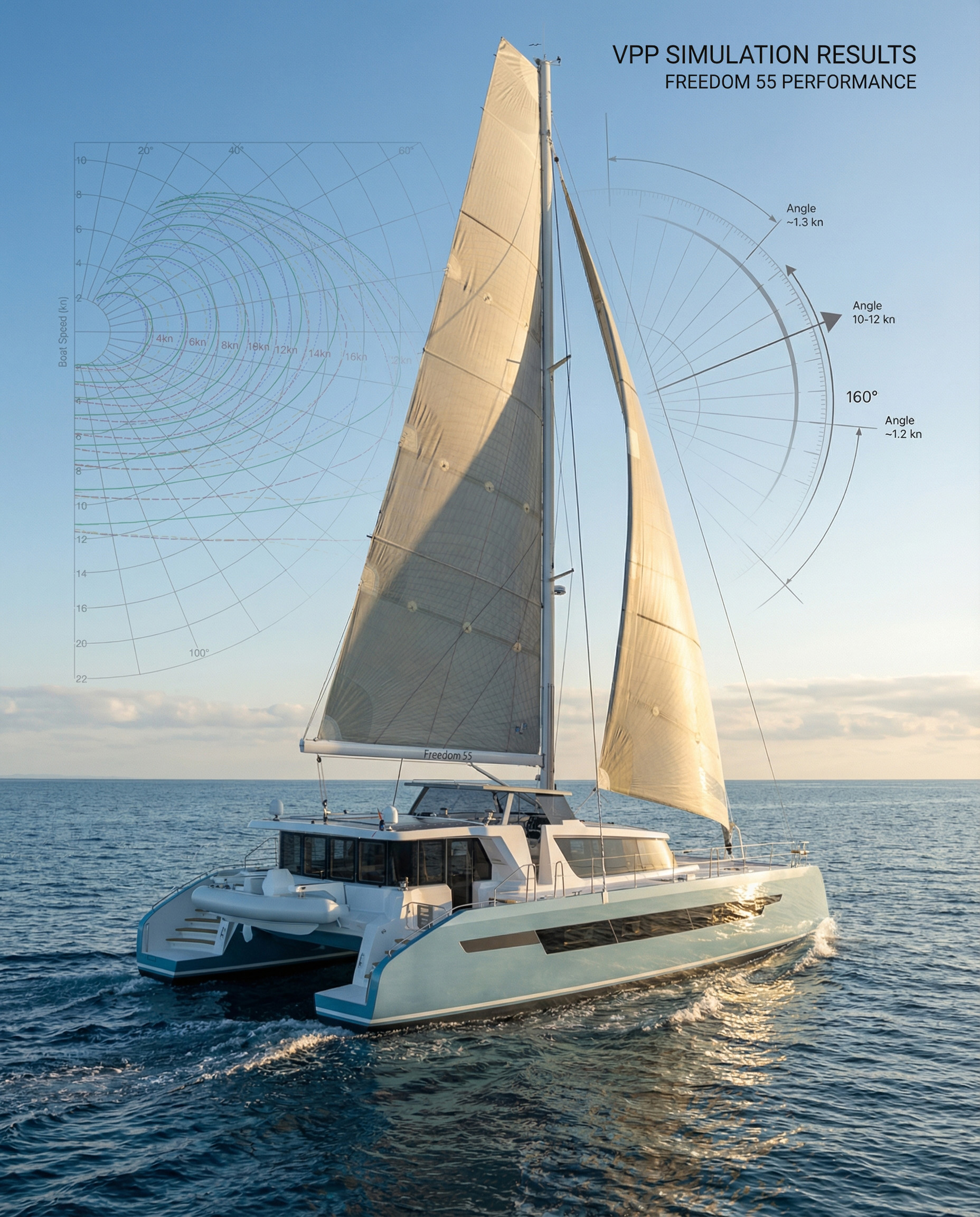
VPP for multihulls and sailboats
A look into a predictive tool indispensable for every sailor
In this article we explore how velocity prediction for sailboats and sailing catamarans integrates within our full-service approach.
Before investing months and hundreds of thousands of euros in construction, how can you know if your sailboat will reach 8 or 12 knots upwind in 15 knots of breeze? Will your sailing catamaran perform as expected in light winds? Which sail combination will deliver optimal speed in varying conditions?
Every design decision impacts performance profoundly, but without prediction tools, the design process lacks a quantitative foundation. This is where the Velocity Prediction Program (VPP) becomes indispensable.
To understand how VPP integrates into our process, we spoke with Veit Spohr and Piers Oest, two of our naval architects based in iYacht’s Kiel office. Both bring extensive experience in sailboat and catamaran design, and Piers also offers the unique perspective of a competitive sailor who uses VPP data during races.
What is a VPP and why it matters
A Velocity Prediction Program is software that calculates a sailboat’s predicted performance across all wind conditions. By solving complex equilibrium equations that balance aerodynamic forces from the sails with hydrodynamic forces from the hull and appendages, the VPP predicts boat speed, heel angle, leeway, and apparent wind for every combination of true wind speed and angle.
Piers explains the practical value: “We use the VPP tool as proof of design to estimate the speed that the owner of the sailboat or sailing catamaran we are designing will be able to reach. Polar diagrams, an output of this calculation, are also very useful material to properly market the boat, as sailors will immediately understand what the boat is capable of just from looking at them.”
For cruising sailors, the VPP provides useful data, but for racing sailors, the value goes even further. “At a higher level, for sailors who compete frequently in regattas, the polar plots obtained from the VPP tool are inserted on onboard displays. This way, when you are sailing, you always know at what percentage you are sailing compared to the VPP predictions,” Piers adds. “In the companionway you always have the polar plot and know which number you need to reach. You are constantly checking: should I go faster or change the angle with the wind? If you are not reaching the performance targets, you know you need to change trim or other factors.”
The VPP is a design tool that turns subjective design choices into data-driven decisions. Rather than relying on intuition or past experience alone, designers can quantify how a deeper keel, a larger sail area, or a different hull shape will affect real-world performance. From the naval architect’s perspective, the VPP is a design tool; from the sailor’s point of view, it is a performance benchmark. Interestingly, Piers, being an experienced sailor, shared the perspective of both sides.
Choosing the right VPP software: WinDesign 4
Selecting the right VPP software is critical, and at iYacht, the decision landed on WinDesign 4, developed by the Wolfson Unit at the University of Southampton, one of the most renowned institutions for yacht design and naval architecture.
“Veit explains the reasoning behind this choice: “We chose to adopt WinDesign 4 after comparing various programs, as it is able to perform VPP calculations on multihulls. Since we frequently work on multihulls, this was a key requirement for us.”
Multihull performance prediction requires VPP software specifically capable of running simulations for catamarans, a capability that many VPP programs simply don’t offer.
Given that a significant portion of iYacht’s portfolio involves sailing catamarans, from series production multihulls to performance oriented designs, this capability was non-negotiable.
For particularly complex projects, we occasionally need even more detailed analysis. In these cases, we import CFD results directly into the VPP for refined accuracy. Having both CFD and VPP capabilities in house makes this integration seamless, another advantage of our full service approach.
Having the right software is only part of the equation. What truly matters is how we integrate VPP into our complete design and engineering workflow
Inputs: building the prediction model
Having the right software is only part of the equation. Another key aspect is integrating VPP into our complete design and engineering workflow. To produce accurate predictions, the VPP requires comprehensive input data about the yacht. This is where the integration with our other design tools becomes crucial.
Veit outlines the essential inputs: “The first input is obviously the hull shape. The program allows you to rebuild the whole surface of the hull, or you can introduce the hydrostatic data of the hull and then the software calculates the drag by itself. We normally use Orca3D to generate the key hydrostatic data of the hull.”
As we discussed in a previous article, Orca3D is the same software we use for running CFD analysis, meaning the VPP works from the identical 3D model used throughout the design process. There is no risk of inconsistencies, and no wasted time rebuilding geometry in different programs.
Beyond the hull, the VPP requires detailed information about every component that affects performance. “Other necessary inputs are rig dimensions, sail dimensions, keel, daggerboards, and all the appendages. Then sail setup and load cases. And last but not least, the weight distribution,” Veit continues.
Weight distribution deserves special attention, particularly for racing applications. The VPP predictions will differ significantly depending on whether the boat is at full load, half load, with tanks full or empty, and critically, where the crew is positioned. “Obviously the VPP output will be different comparing full load conditions to regatta conditions, when all the people onboard are positioned on the windward side,” Veit notes.
This variability is precisely why accurate input data matters. If the hull hydrostatics are approximated, if sail dimensions are estimates rather than precise measurements, or if weight distribution is guessed, the predictions will be correspondingly unreliable.
At iYacht, the advantage of having design, naval architecture, and VPP under one roof means that all input data comes from the same source files, maintained and updated throughout the project. This consistency is foundational to producing predictions that clients can trust.
Outputs: polar plots and performance data
The primary output of any VPP is the polar plot: a diagram showing predicted boat speed at various wind angles and wind speeds. For anyone familiar with sailing, these plots are immediately readable and incredibly informative.
For racing sailors, polar plots become performance targets. Major marine instrumentation brands allow sailors to upload VPP data directly into onboard electronics, providing real-time feedback on whether the boat is achieving its predicted performance.
However, Piers is careful to set realistic expectations about VPP accuracy. “The VPP tool is not meant to deliver 100% accurate speed predictions. It is not about exact figures. It is about the trend. In sailboat racing, you continually do test runs and adjust the VPP data. It is an ongoing development, a continuous iteration towards the limit of the boat.”
This means that sailors test, measure, adjust the VPP inputs based on real data, and refine predictions over time. This continuous feedback loop pushes both boat and crew toward the theoretical performance limit.
VPP predictions are based on calm water conditions with steady wind, ideal conditions rarely found in reality. Waves and other variables mean actual performance will differ from predictions. “We also have to bear in mind that the VPP gives us calm water numbers, so if there are waves, predictions can be less accurate,” Piers notes. Despite this limitation, the VPP remains invaluable for understanding performance trends, comparing design alternatives, and setting realistic expectations for boat capability.
The VPP report: practical deliverables
iYacht’s clients receive a comprehensive report after VPP analysis, including detailed tables covering reef points, rudder angles, keel or daggerboard angles, optimal sailing courses, and target speeds across varying conditions. Most critically for sail selection, tables correlate wind angle and wind speed with the recommended sail configuration.
“For a recent project, a 54-foot sailing explorer, in the table we identified different sail configurations to adjust to various wind conditions,” Veit explains. “One configuration for upwind sailing, another for light wind conditions, one for downwind, and another for dealing with strong wind.”
These are not arbitrary recommendations. The VPP calculates which sail combination produces optimal performance for each condition, considering not just speed but also stability, balance, and safety margins. This guidance helps clients know which sails to combine to reach optimum performance without compromising the boat’s handling characteristics.
Reef tables warrant special attention, particularly for sailing catamarans. “Reef tables are always with you when you sail, and are extremely important for sailing catamarans to avoid capsizing,” Veit emphasizes. Unlike monohulls, which have ballasted keels providing ultimate stability, catamarans rely on beam and buoyancy distribution. Excessive sail area in strong winds can lead to capsize.
“The reef is displayed as a percentage. It is important not to exceed the percentage indicated to avoid capsize risk,” Veit notes. “It indicates how much you need to reduce the sail area to maintain the boat’s stability and balance in high winds.”
These tables provide clear guidance to the crew, remove guesswork, and offer confidence that the boat is sailing within safe limits while still optimizing performance.
The full-service advantage
Many design studios outsource VPP work to specialized consultants. The typical workflow involves sending design data to a VPP specialist, waiting for results, then repeating the cycle with each modification. This creates timeline delays, higher costs, and the risk of data inconsistencies from manual transfers between different software systems. Most critically, no single entity owns the complete integration between design, performance prediction, and structural engineering.
At iYacht, design, naval architecture, VPP analysis, CFD, structural engineering, FEA, and CE certification all happen under one roof, executed by one coordinated team working from unified design files.
The practical advantages are immediate. When VPP analysis identifies a performance improvement opportunity, we evaluate that change across all disciplines simultaneously. As Veit explains: “We can test a new keel shape in the CFD, analyze results with the design team, run a VPP, and quickly iterate based on findings.”
With over 20 years of experience, 100+ completed projects, and 38+ CE certifications processed annually, we have refined our workflow to be both efficient and reliable. Having all disciplines in-house means clear accountability, predictable timelines, and consistent quality. Our integrated approach is not just faster: it is more reliable, delivering what we promise at the project’s start.
Whether you are developing a production sailing catamaran or a one-off performance cruiser, accurate performance prediction is critical. Contact us to discuss your project and discover how our full-service approach delivers better results.
VPP for multihulls
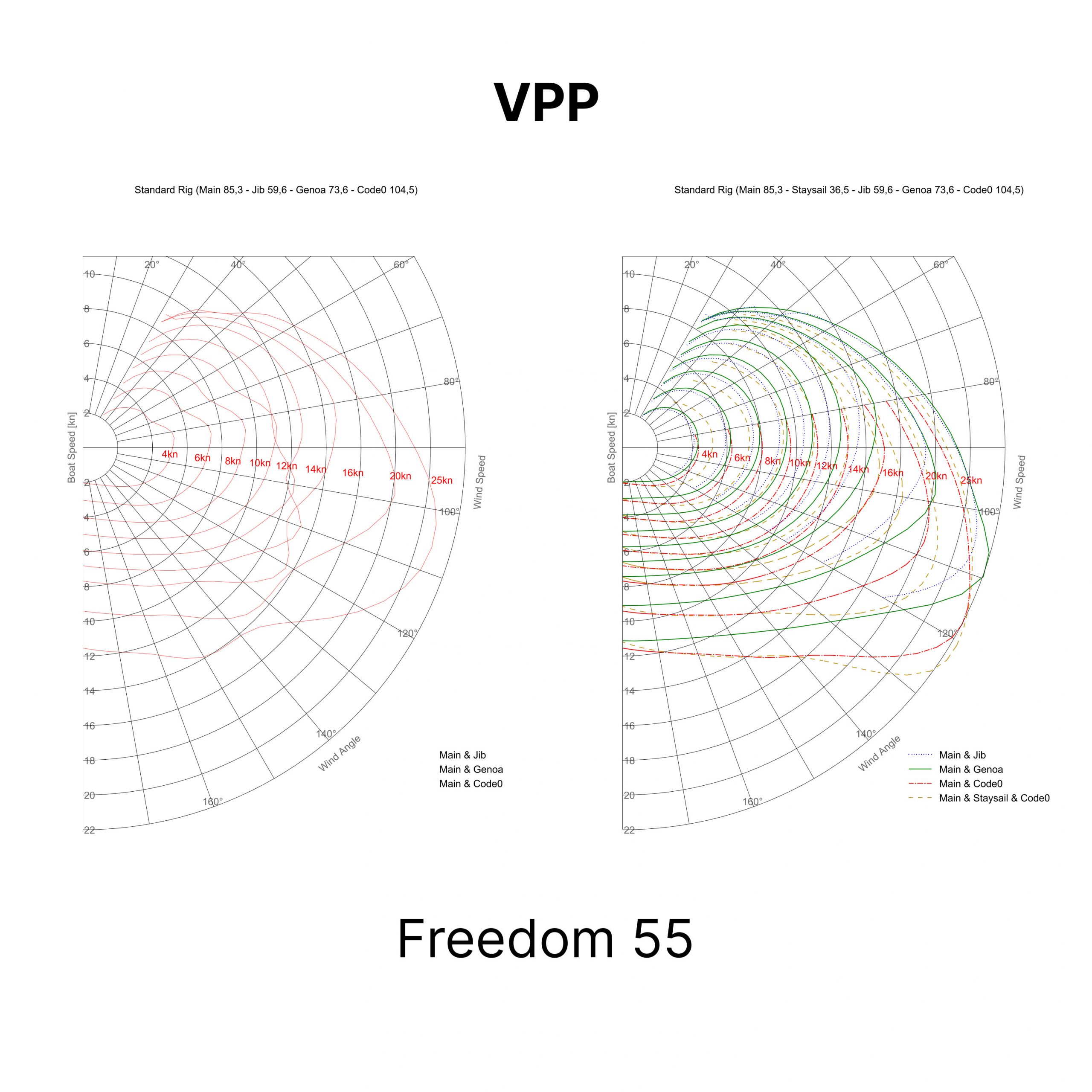
Polar plot VPP for multihulls